
13 December
Lucia
How to say it
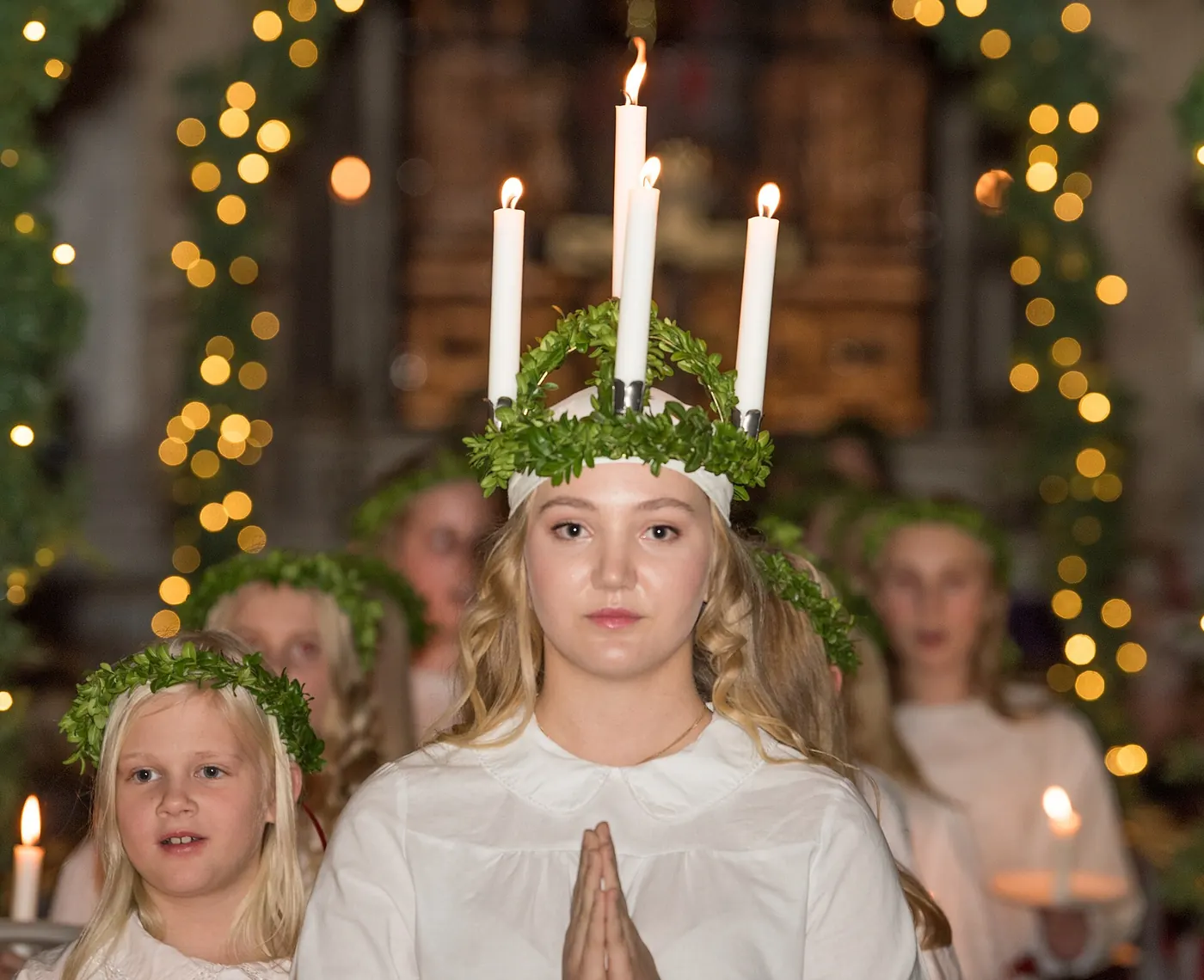
Lucia is celebrated on 13 December and is one of the ways Sweden prepares for Christmas. At its heart is the luciatåg, a singing procession led by a Lucia in white, with a crown of candles on her head and a red sash round her waist.

Where it comes from
The name comes from the Latin lux, light. Saint Lucy was a young Christian woman from Syracuse in Sicily who was killed on 13 December 304. Her feast stayed in the calendar of saints and remained in the Swedish Catholic calendar until the 16th century.
Under the Julian calendar, the night of 13 December was the longest of the year. In rural belief it was a dangerous night: supernatural beings were about, animals could talk, and it was best to stay awake. Baking, threshing and brewing had to be finished by Lucia Day, which was marked with extra food and drink.
The modern form grew up in western Sweden, on the manor estates around Lake Vänern. The earliest record of a white-clad figure visiting people at dawn dates from 1764. The first known Lucia with candles on the head, in 1820, was a man: a farmhand at Skinnskatteberg.
In the early 1890s Artur Hazelius brought the custom to Skansen, the open-air museum in Stockholm, to show it as a rural tradition. In the late 1920s the newspaper Stockholms Dagblad held a competition to choose Stockholm's Lucia, with a public procession through the city. Other papers copied the idea and the custom spread across the country.
By the 1950s the procession was common throughout Sweden. By then Lucia had reached Finland, where she became a symbol for the Swedish-speaking minority, and Denmark, where she was taken up in 1944 as a silent protest against the German occupation.

How it is celebrated today
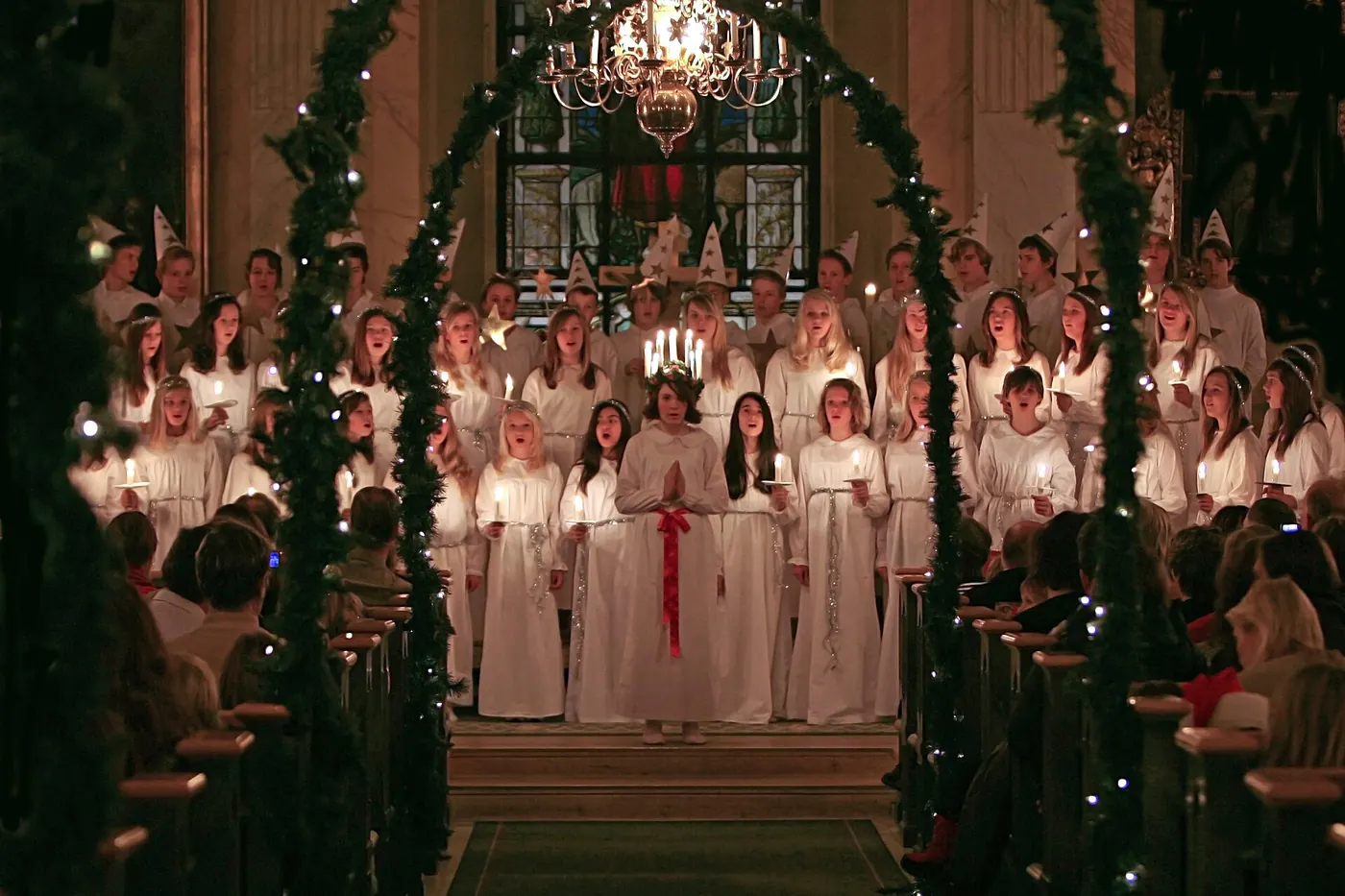
Today there are Lucia processions in nurseries, schools, churches, workplaces and care homes, and Swedish television broadcasts one every year. Behind Lucia walk the tärnor, also in white with tinsel or wreaths in their hair, and the star boys, who sing the Staffan song. The youngest often dress up as tomtar or gingerbread figures.
After the singing comes lussefika: coffee or glögg, something for the children, saffron buns and ginger biscuits. The largest Lucia concert is held at the Globen arena in Stockholm with more than 1,200 performers. At the Grand Hôtel it is a tradition to wake the Nobel laureates who stay on after the 10 December ceremony with a Lucia procession.
Words for the day
Tap a word to hear it.
- The Lucia procession.
- One of Lucia's white-clad attendants.
- Star boy, part of the procession.
- Lucia saffron bun.
On the table
- lussekatt
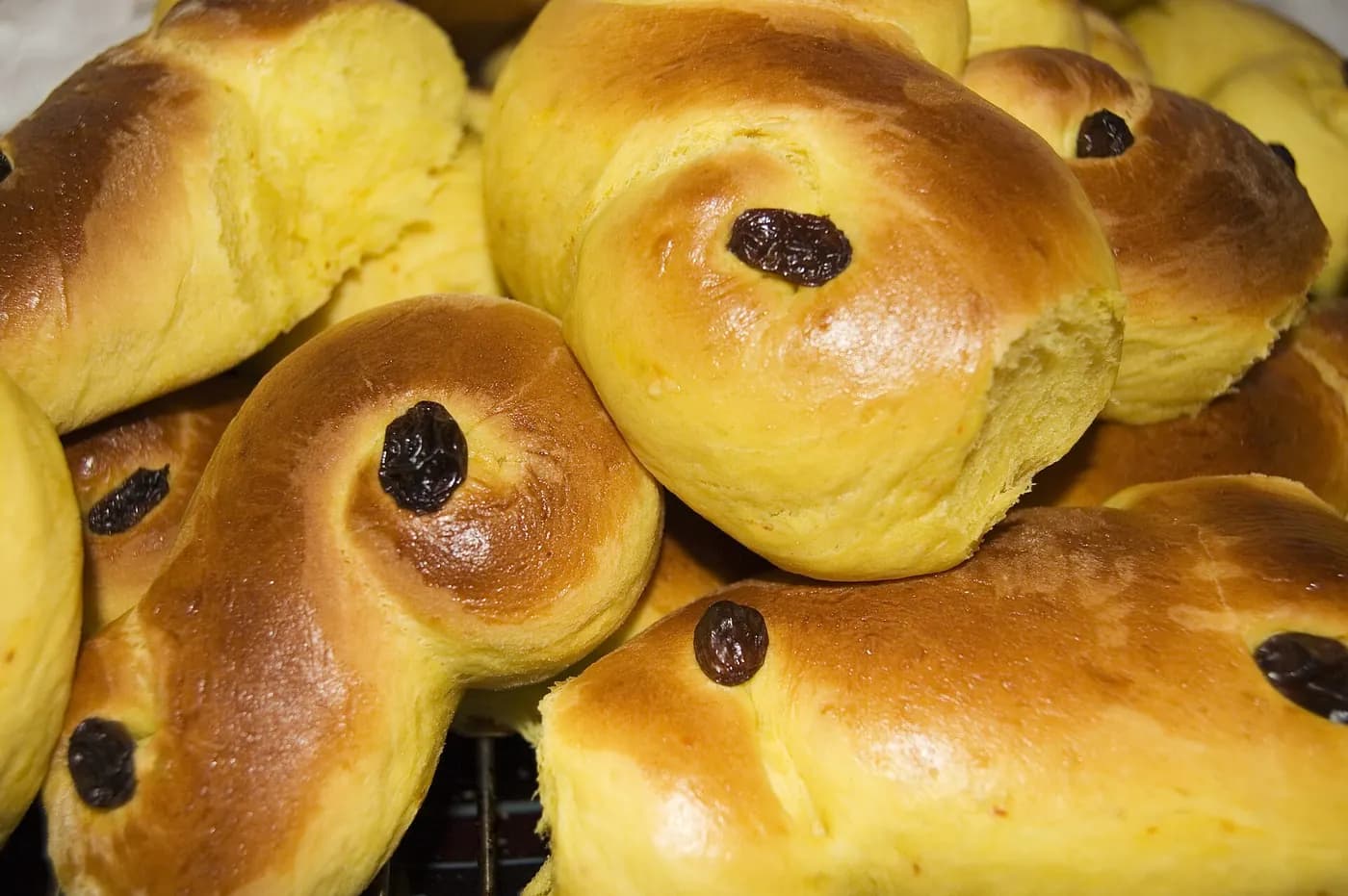
- An S-shaped wheat bun, yellow with saffron, with raisins. Saffron was added in the late 19th century.
- pepparkakor
- Thin, spiced ginger biscuits.
- glögg
- Hot spiced wine.
- kaffe
- Coffee, served at the lussefika.
What people sing
- Natten går tunga fjät
- The most widely sung Lucia lyric, written by Arvid Rosén in 1928 to the Neapolitan tune Santa Lucia.
- Sankta Lucia, ljusklara hägring
- An older lyric by Sigrid Elmblad, published in 1924, to the same tune. It has regained popularity since the late 1980s.
- Staffan var en stalledräng
- The star boys' song. Staffan songs are recorded from the Middle Ages.

From Chile
In Sweden 13 December is one of the darkest days of the year, and Lucia brings candlelight into the dark. In Chile it is one of the longest days, just over a week before the summer solstice, so the Lucia song is sung in broad daylight.